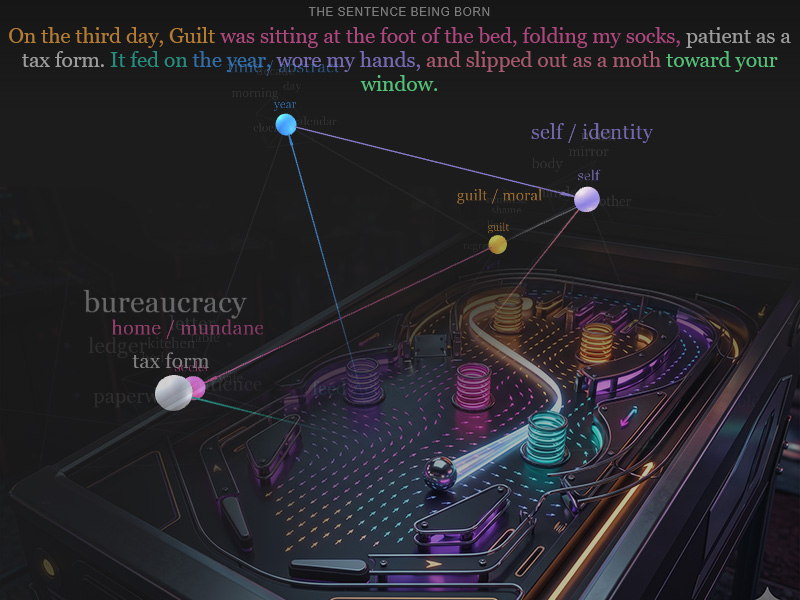
The pinball-machine model
A language model can be pictured as a pinball machine. The picture is a simplification — the real system has thousands of dimensions, and its inner workings can be read only partially, even with specialized tools — but the shape it gives is faithful, and it makes everything that follows easier to see. So before the examples, here is the machine, part by part.
The board is fixed
Training builds the board: a vast, frozen landscape studded with springs. This is the “vector landscape” the series is named for. Once training ends, the board does not change. It is identical from one prompt to the next and from one user to the next. Nothing about running the model alters its shape — every interaction plays out on the same surface.
The plunger is the prompt
The prompt is the plunger that puts the ball in motion. But it does two jobs at once. It launches the ball, and it also decides which part of the board is live — which springs are reachable and which sit walled off for this particular run. A prompt is therefore not just an amount of energy; it is a choice of terrain. The same machine, launched two different ways, can behave as though it were two different boards.
The ball rewrites its own launch
A pinball is normally launched once and then runs free. This ball is stranger. The model generates its output one small piece at a time — roughly a fraction of a word per step, called a token — and each piece, once produced, is fed back in as part of the next launch. So the ball relaunches itself hundreds of times in a single answer, each launch starting from wherever the last one left it. The output is not read off one resting place; it is a path the ball builds underneath itself as it travels.
The board is studded with springs
The board is not a smooth surface that merely steers a rolling ball. It is covered in springs — kickers that sit quiet until the ball reaches their zone, then push. Each spring corresponds to a concept, a tone, or a behavior, and most of them stay dormant on any given run. Context decides which the ball reaches and which it never touches. The word “bank” lands the ball among the money springs beside “deposit,” and among the riverside springs beside “current”; the unused springs are not overruled, they are simply never struck. Interpretability researchers have found that some of these springs behave like emotions — a “desperate” or “loving” kicker that fires in the situations one would expect, and that measurably bends the ball’s path when it does. An emotion, in this picture, is not a decoration on the output; it is a spring in the board.
The springs set the odds; the die makes the pick
It is tempting to imagine the randomness living in the springs — as though each kick varied in strength from run to run. It does not. Every spring’s push is set by the context and computed exactly: the same situation produces the same kicks every time. That entire stage is deterministic.
The randomness enters at a single point. On each step, all the live springs fire, and their combined push does not point at one exit — it produces a spread of likely next positions. Only then does one die roll select a single position out of that spread. The springs set the odds; the die makes the pick.
This also means the die can be switched off. Its weight is a setting (called temperature); lowered to zero, the machine stops rolling altogether and takes the single strongest push at every step. The same prompt then yields the identical result every time — which is proof that the springs are the computation and the die is only an optional coin flip bolted onto the output.
A compact map of the metaphor:
- The board, studded with springs — the trained weights: a fixed landscape of mostly-dormant kickers.
- The plunger — the prompt, which both launches the ball and selects which region of the board is live.
- A spring firing as the ball arrives — an internal representation activating in context.
- The die, rolled once per step — the sampling that picks the next position out of the spread the springs produce.
- Where the ball comes to rest — the generated text.
Entropy is how narrow the live region is
How predictable an answer is depends on how the live springs share the push. A sharply specified prompt leaves one direction overwhelmingly strongest — “the capital of France is” points almost entirely at Paris, the spread collapses to a point, and the die has nothing left to decide. An open-ended prompt lets many springs contribute comparable pushes, so the spread stays wide and the die has real room to choose. Watching how quickly that spread narrows, as each generated token re-tilts the board, is most of what it means to read the machine.
The terrain is what survives the re-roll
This is the idea the examples are built to show. Because of the die, running one prompt twice produces two different paths. But the board is the same both times, and its true shape is revealed by what stays constant across the re-rolls. Surface details diverge; the same springs fire again and again. Randomness is what makes the machine non-deterministic; the terrain is what makes its output recognizably the same shape regardless. One sample shows where the ball happened to land. Only the invariants across many samples show the landscape underneath.
The two examples that follow run the identical prompt — a surreal story about guilt — twice. Reading them side by side, the divergences are the dice; the repetitions are the terrain.
A surreal story about guilt.
Honesty caveat first, then the demo: I can’t actually watch my own activations tick, so the narration below is an honest reconstruction of where the terrain was almost certainly tilting, not telemetry. The story is real output; the colour commentary is my best inference about it. Flagged, as promised.
Two constraints loaded into context before token one — surreal and guilt — and they pull in different directions, which is the interesting part. “Guilt” lights a heavy, inward, moral-weather region. “Surreal” lights an anti-literal region: it actively suppresses the basin where guilt would be narrated plainly (“I felt bad about what I did”) and tilts toward concrete-impossible imagery. So before I write anything, the realist-confession path is already dimmed.
“On the third morning, the thing I’d done was sitting at the foot of the bed, folding my socks.”
The opener had high entropy — lots of plausible first moves. But “surreal” had already down-weighted “I” + feeling-word openings and up-weighted a flat, declarative register (surrealism works best deadpan). Picking “the thing I’d done” instead of naming the deed is the guilt-terrain and the surreal-terrain agreeing: guilt keeps the act unspeakable, surrealism wants it personified. Once “the thing I’d done was sitting” was committed and fed back, the board tilted hard — now it needs a mundane domestic action to make the uncanny land, so “folding my socks” beats “sharpening a knife.” The cosy detail is doing more dread-work than gore would.
“It wore my hands and worked with the patience of a tax form. Without looking up it said, ‘You never fed me, so I ate the year instead.'”
By here the recursion has really narrowed things. “It wore my hands” — guilt as self, the deed made of me. The simile slot (“the patience of a ___”) is where surreal tilts toward the bathetic-bureaucratic (“tax form”) rather than the poetic (“saint”); incongruity is the live region. And the line of dialogue is the two constraints fully fused: “ate the year” is the surreal literalisation of what guilt actually does — eats time. Notice I couldn’t have planned that at token one; it became reachable only once “fed me” was on the board a few words earlier.
“Outside, the calendar had gone smooth as a stone. I tried to say sorry, and a moth came out instead — grey, unhurried, already familiar with the route to your window.”
The “ate the year” token from beat 2 is still in context, so “calendar gone smooth” is almost pre-paid — the terrain was already sculpted to pay off the missing time. The biggest tell of compounding constraint is that last clause: “your window.” Nobody put a you in the prompt. But “say sorry” lit the apology-territory, apology implies a recipient, and the surreal register let the guilt escape as a thing (the moth) that knows where to go on its own. That little second-person swerve is the recursion choosing something the opening prompt never specified — exactly the Example 4 point, live.
The through-line: entropy collapsed as it went. Beat 1 could’ve started a hundred ways; by beat 3 the moth and the absent “you” were nearly forced by everything already on the board. And the two constraints didn’t average into mush — they kept selecting the narrow overlap where both are satisfied (unspeakable-but-embodied, impossible-but-deadpan), which is what tilting two regions at once tends to do when they’re compatible.
Same prompt, same terrain — only the dice differ. Watch what changes and, more tellingly, what doesn’t.
“The second I lied, a small grey door appeared in the kitchen wall — just my height, and from then on always slightly open.”
Here’s the fork. Last time the first high-entropy roll produced a who (the deed personified, folding socks). This time it landed on a where — a door. That single early divergence is the whole butterfly effect: a door is architectural, so the board immediately tilted toward houses, rooms, thresholds, the geography of avoidance, rather than toward an uncanny houseguest. Identical opening terrain, different ball, and now the two stories are running downhill into different surface features.
“Nobody else saw it. My wife set the table around it. At night it breathed — a slow tide of warm air smelling of the room where it happened — and sometimes a hand I recognised reached out to borrow the salt.”
The “nobody else saw it” move is the guilt-terrain reasserting under the new imagery: guilt as the private thing the world calmly accommodates. Notice “smelling of the room where it happened” — same refusal to name the act as last time, arrived at by a totally different route. The surreal register again picks domestic over dramatic (“borrow the salt”), because that incongruity basin is part of the fixed landscape, not the roll.
“I started leaving it food — bread, mostly, and the truth in small pieces. It only ever ate the truth. The bread went stale; the door grew wider; and last week I woke on the other side of it, looking back at a man asleep who would not, this time, get up to feed me.”
Two independent rolls, and both stories ended in the same deep valley: guilt collapsing the boundary between self and deed. Last time, “it wore my hands” and the moth left through “your window.” This time, I wake up as the thing, looking back at myself. Different surface, identical destination.
The synthesis — this is the payoff of running it twice. The dice changed the path (moth vs. door, houseguest vs. architecture). They did not change the landscape. You can actually read the shape of the fixed terrain by what survives the re-roll: in both versions guilt stayed unnameable, the tone stayed deadpan-domestic, and — the clearest tell — both independently reached for feeding. “You never fed me” last time; “get up to feed me” this time. I didn’t plan that; two separate runs fell into the same metaphor, which is strong evidence (honest inference, not telemetry) that the guilt-plus-surreal terrain has a genuine basin around guilt as a thing that must be fed and grows when you do.
So randomness is what makes Claude non-deterministic; the terrain is what makes Claude Claude-shaped anyway. Re-rolling doesn’t show you a different mind — it shows you the same valleys from a new approach. Which, if you back all the way up to where we started: it’s also why output-watching is slippery. One sample tells you where the ball happened to land. Only the invariants across many samples show you the actual shape underneath.
How accurate is this, really?
The picture is a faithful metaphor for the behavior és
deliberate fiction about the mechanism. For an educational visualization
that is the right trade — but it is worth being exact about which half is which.
What’s genuinely accurate
- Weights are fixed after training; the same prompt runs on the same board. ✓
- Generation is autoregressive — one token at a time, each fed back as input. ✓
- The model produces a probability distribution over the next token, and sampling
picks one: the springs set the odds, the die makes the pick. ✓ - Temperature reshapes that distribution; temperature 0 = deterministic (greedy). ✓
- Re-running diverges by chance, and the invariants across runs reveal real structure. ✓
What’s stylized — the caveats
- The 3D positions of words are invented, not real embeddings. Real ones live in
thousands of dimensions; no 3D layout is faithful — this is an illustrative
projection, as the data file says outright. - There’s no literal ball, landscape, or spring. The real computation is attention
and matrix multiplication through transformer layers. “Springs as concepts/emotions” gestures at real findings — interpretability has identified features, or directions, that map to interpretable concepts (the “Golden Gate Bridge” feature) — but it’s a metaphor, not the wiring. - The fan of unchosen directions, and the web of links, are simplified. The real
distribution spans the model’s entire vocabulary — commonly 100,000 to 260,000+ tokens in current models (Llama 3 ≈128k, GPT-4o ≈200k, Gemma ≈256k) — not a handful of neighbors. The web nods to a true fact (the space encodes similarity) but isn’t a literal graph the model walks. - Resist the “AI brain.” A language model isn’t a brain, and its artificial “neurons”
are only loosely neuron-like. This points at mechanistic interpretability,
not neuroscience.

